Pages

Showing posts with label Celtic. Show all posts

Tuesday, July 1, 2014

Sound Sample of Rick's Tenor Guitar

Rick was kind enough to record a video of him playing his arrangement of Turlough O'Carolan's Si Bheag Si Mhor. He also starts off with a bit of a video montage of the guitar.

I have to say I'm very happy with how the guitar sounds and how much Rick seems to like it..
Thanks for the video Rick!


https://www.youtube.com/watch?v=S7v9rxejlOE&sns=fb

Sunday, May 25, 2014

And it's Done

Complete finished done.. Sounds good, ok sounds better than the ladder braced Celtic tenor I made a while back, more sustain and a bit deeper sound.. Probably due to the slightly bigger body.. Also the sustain might be a combination of the stiffest top I've used so far and the relatively thick saddle...

I was anticipating have to do compensation on the saddle to get the intonation right but if anything it's a bit flat so none was needed.. The thicker saddle might? be better at energy transfer to the top?? I'll have to do a bit of reading up on that.

Next, I've got to finish the parlour guitar which I've just started carving the neck on and I have the original Mandocello I made that need a new top. A carved & properly arched one this time .....


Thursday, April 4, 2013

And It's Playing Music

The Celtic Tenor Guitar is finished.. it has a coat of blonde shellac French Polish , Schaller gold tuners with ebony buttons and an Allen Tailpiece. Currently it is strung with 0.042, 0.030, 0.020 and 0.012 strings tuned to GDAE an Octave lower than Mandolin. So it's a Tenor Guitar tuned as an Octave Mandolin :-)

The strings are a bit floppy on it so I'm going to replace them with some Mandola strings which as 0.049, 0.034, 0.023 & 0.014 Which should give 21 to 23 pounds string tension across the board.

All in all I'm happy with the results, it has a Mandolin like sound and should be good for playing Celtic pieces.. One I sort ou the strings I'll try and post a sound clip.


Saturday, March 2, 2013

Cutting Shell and Inlaying

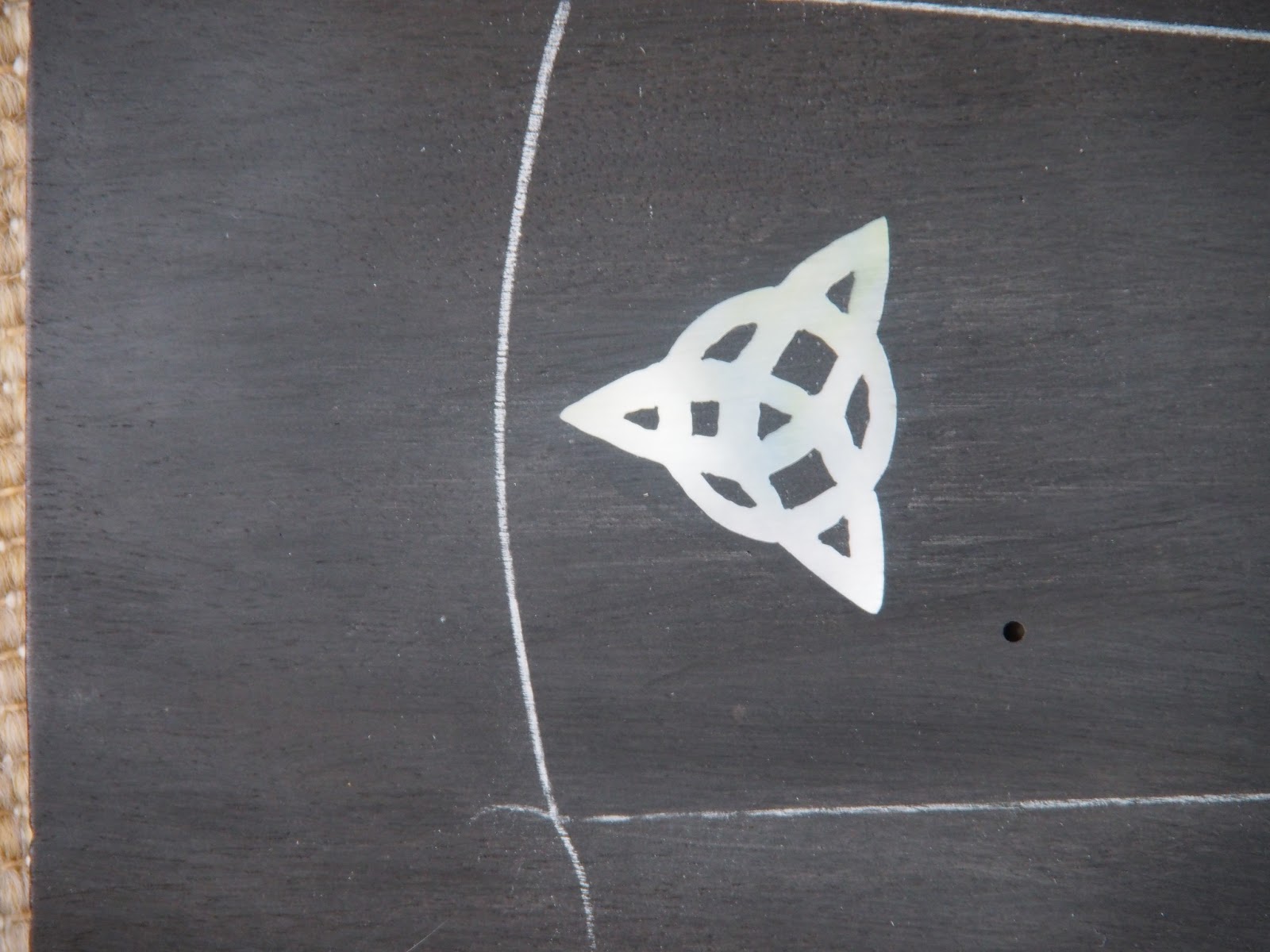
I've done one simple inlay before, since this is what I call a Celtic tenor guitar should have a Celtic inlay.. So gave that a try.. The inlay will go on the peghead.. I tried a couple of methods to cut the shell but in the end went with the tried and true jeweler's saw and needle files..

I considered trying to leave some wood in the voids between the arms of the design when I routed out the opening but decided they were so small it would be impossible. So I routed out the entire shape and glued in the shell with 5 minute epoxy coloured liberally with lamp black.. Left everything a little high then sanded smooth..

All in all I think it worked out good!


V block & Jeweler's saw with the cut out design
Just sitting on top of the neck

the pocket for the shell routed

glued in and filled with epoxy and lamp black

sanded smooth


Thursday, February 7, 2013

Thicknessing and Jointing

Tonight I thicknessed the sides and jointed the back. Rough thickness is obtained using a Safety Planer and the final thickness is obtained using a home made drum sander.. Sides are about 2mm and the back right now is about 3mm which is a bit think bit I might try leaving it there, not sure. My idea is that the thicker = stiffer back might give a bit more projection from the small instrument.. Not sure if I will leave it at that thickness or not...

The Safety Planer, used by many Luthiers

I very simple jig to hold the far side of the wood down as it goes through
Back Jointed using a simple Jig

I'm also getting ready to route the dovetail mortise in the heel block, I'm doing this early on in the process as opposed when the box is closed, I'm thinking I prefer this but this will be the test.

Anyway here is the jig I made set up to route the dovetail using a template from LMI.


Monday, February 4, 2013

On to the Next One

Most people who build guitars will tell you it is a bit of an obsession. I guess I am no different in that regard, I've been bitten by the bug..

Building something that is both beautiful and beautiful sounding is very satisfying.

So the next guitar is a small tenor based on a Regal tenor guitar from the 1920's with a 21" scale length, 12 fret to the body and floating bridge and tailpiece.. I calling it a Celtic Tenor as I plane to try to optimize it for GDAE tuning as a sort of octave mandolin.. It should work well for Celtic style playing.

The Shape will be that of the Regal but I plan on changing a few things most notably the materials

Back and sides will be Koa, with and Englemann Spruce top, the neck will be Cedro (Spanish Cedar), with and Ebony fretboard, most of the trim will be Ebony..

The Raw Material
I'll be doing a few things different in the build process as well since I think I have a few methods in mind that work better for me.. First off I'll be using the universal mold I made, I don't have the space to keep making separate molds for each guitar type I make.. It also has what I hope are a few other advantages this I'll talk about as they come up.

Template used to set up mold


Template removed


On to the Next One

Most people who build musical instruments will tell you it is a bit of an addiction . Guess I am no exception, it is a very special feeling to build something that not only looks good but sounds good!

So off we go with the next guitar, his one is a small tenor based on the 1920's Regal Tenor Guitar